Wednesday, February 2, 2011

Samba

On Sunday night, Rita and I took Helena Iara to the park, but in January in Brazil, things aren't quite so simple: the Escola de Samba União da Ilha had taken over the little plaza in the center of the Lagoa neighborhood, and was in full scale preparation for carnaval.  Maybe fifty zabumbas (base drums), thirty tamborins (not like a US tambourine, this one has no bells, and it's hit with a stick), dozens of cuicas, cavaquinhos...  A furious and joyous sound.

Looking back over Sunday night, when Helena slept really badly, I think that we probably over-did the noise and stimulation, but Helena loved it.  She sang along with the music (she has about a two note range now, but a decent sense of rhythm), danced by swinging her head back and forth, and played games with anyone she could find.  It's very clear that she loves samba.

Samba is one of those art forms that a lot of people use for thinking life through, and for making manifestos about art.  This morning, as she and I sat in the hammock after breakfast, I sang Helena one of these songs, Desde que o Samba é Samba, by Gilberto Gil and Caetano Veloso.  The lyric she paid most attention to, and the central one to the philosophy of the song, is

O samba é pai do prazer                             Samba is the father of pleasure
o samba é filho da dor                                Samba is the child of pain
o grande poder transformador                    The great power of transformation

Brazil is famous for alegria or constant joy, but the truth of the matter is much more complicated: the history of the country, especially for those who make the extraordinary art and music that gives Brazil its reputation, is full of tragedy: slavery, war, hunger, social exclusion.  The people are happy not because of who they are or what they have lived, but because they use art to struggle to win joy out of pain.  That's why samba is the child of pain, but the father of pleasure.
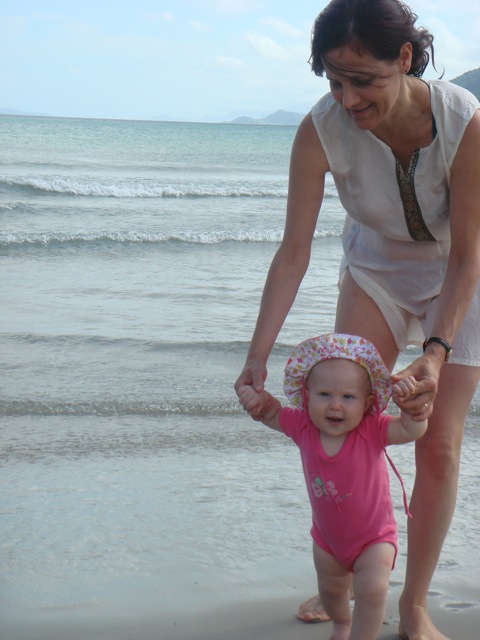
Helena Iara has been living something similar over the last several weeks, as she learns to control her mouth and breath and begins to utter sounds that seem more and more like words.  The miracle of language is that, like samba, it can turn pain into pleasure: think of the enjoyment of a movie with a tragic ending, or the elegant feeling of grace at the end of a novel by Henry James.  Virgil may have put it best in the words of Aeneas:

Vos et Scyllaeam rabiem penitusque sonantis

accestis scopulos, vos et Cyclopea saxa

experti: revocate animos, maestumque timorem
mittite: 
forsan et haec olim meminisse iuvabit.

"You have braved the fury of Scylla, the deep-ringing boom
of her craggy home, you have faced the rocks of the Cyclops.
Pluck up your courage, let fear and sadness alone --
Perhaps, one day, even this will be good to remember."

As Helena finds more words and word-like sounds, she has cried less, complained less, and enjoyed more things (sitting and reading a book with me, singing...).  Words that turn the challenge of a belly-ache or a baby's tedium into art.  Her babbling songs may not be as beautiful as the words of Virgil or the voice of Caetano Veloso, but that's what they're striving for.

Monday, January 31, 2011

Falling down

As Helena Iara has been learning to stand and walk, I've discovered that she loves to fall.  Not all the time, of course, and she'll cry when her hear hits the floor, but on a nice soft surface, or when she just lands on her butt, she'll look up with a blissful smile.  So this weekend, I told her a story of an encounter I had with a teenager living on the street, about a decade ago when I was working with street kids in Santa Fe.  Since I wrote a radio commentary about the story back then, I'm going to shamelessly plagiarize myself here:

            Last week, one of the homeless kids I work with came into the drop in center elated.  A friend had loaned him a snowboard and taken him up to the Santa Fe Ski Basin, and the experience had left a smile on his face that I didn’t think even surgery could remove.
            “You’re not just dead?”  I asked, remembering my first day on a snowboard, where have a zillion flips over my toe-side edge had left bruises on my palms and sorer muscles than anything else I could remember. 
            His smile grew a touch more thoughtful.  “Sure, I crashed a lot, but I’m good at falling.”
            Several days later, the same kid came in.  Perhaps he had gone to the plastic surgeon, I thought at first, because that permanent smile had been completely effaced.  We talked for a while, played a game of chess, and finally, slowly, the truth began to come out.  The sort of truth that fulfills everyone’s nightmare.
            Several months before, an acquaintance had invited him and his girlfriend to sleep on his floor for the winter.  At the time, it had seemed a kind gesture.  But then, yes, the hero of my story walked in on his girlfriend and their host.  Naked.  In bed.
            My heart contracted.  He moved his knight to put my king in check.
            “I’m so impressed with how you’re handling this,” I said, reaching for any good thing to say, any silver lining to the blackest cloud a young man can have pass in front of the sun.
            “Remember what I told you?” he asked.  “I’m good at falling.”
            If there’s any truth to the old saw about how suffering builds character, it’s in those few words.  And unfortunately, because life has become so easy for most middle and upper class Americans, we have no chance to learn how to fall.  I imagine an average kid thrown into the same circumstances -- he would demand years of therapy, a prescription for Zoloft, and a new puppy.  For a kid who’s been homeless for years, who’s been knifed in the back by his father -- sure, the experience is further evidence that life sucks, but it does not destroy him.
            On the streets, among the orphans, the girls who were sexually abused for years, the gay boys kicked out of the house by their dads, and children from families too poor to support them, there are also some rich kids.  The life of Jack Kerouac seems romantic to them, and they might talk about the joys of the open road, but in truth, they want to learn how to fall.  Most children from American families have no chance to find out what they’re made of, to see if they are worthy of themselves.
            So in the end, there’s a simple lesson and a more complicated application.  We all need to learn how to fall better -- the question is how.
            Maybe I’ll try snowboarding again.
            This is Kurt Shaw for Radio for Change dot com.
 You can see why I'm so excited that Helena is learning to fall.


Saturday, January 29, 2011

Identity and Memory

This week, Helena has come to love books.  Now, she's always enjoyed standing in front of the bookshelf and looking at the spines, and more recently, in trying to pull them out and throw them on the floor, but this week she learned how to turn the pages, look at the pictures and relate them to the story... a book as a book, not as a mere object.

In the process, she's concluded that her favorite book is Little Gorilla, the story of a baby gorilla loved by everyone in the jungle, and his anxiety about growing up, because if Little Gorilla isn't little anymore, will everyone still like him?  I think this deeper theme still escapes Helena Iara, but she loves the pictures of all of the different animals, and thinks that the lion is especially great (she has a stuffed lion, whom I bring into the story with a roar).

Yesterday, with each page that she turned, she reached onto the page to touch Little Gorilla, finding his little black form on almost all of the pages (though not when just a hand or foot represents the character metonymically: that's a hard step intellectual, I imagine).  At first, recognizing the gorilla doesn't seem like that big a deal, but the book represents the little baby in lots of positions, doing many things, and eventually Little Gorilla gets big, and looks almost nothing like himself.  Yet Helena always recognized him.

I told her a story of José Luís Borges, Funes el Memorioso, where the protagonist has perfect memory, and can re-create any day in his life in exact detail.  Soon, he concludes that language is insufficient for his world: "It annoyed him that a dog at 3:14PM (seen from the front) would have the same name as a dog at 3:15 (seen in profile)."  In the end, the perfect detail of his memory made abstraction, generalization, synthesis -- all of what we call thinking -- impossible.  Unable to forget, he was unable to remember, or at least remember as we use the word.

 Helena's recognition of Little Gorilla on many different pages, in many different incarnation, is a kind of forgetting of difference, a recognition of what matters and what doesn't, and as such, something that makes thinking possible.

Tuesday, January 25, 2011

11:30

For the last several days, the Brazilian all-news-all-the-time station has been promoting an interview with Slavoj Zizek, one of my favorite philosophers and someone who shows up pretty often in this blog.  (If you want an interesting thought experiment on how bad the American media is, try to imagine what it would take to put that kind of marketing campaign into an interview with a philosopher on Fox News or CNN)  Unfortunately, GloboNews planned to show the interview at 11:30 at night, well after I prefer to be asleep.

Helena Iara fell asleep earlier than usual, and Rita and I prepared for a good night, but at 11:15, a certain small person decided that she did not want to be asleep.  Nor did she want to play in her crib, in bed, or in the hammock.  She wanted to go downstairs.

Now, one can argue about whether or not her real purpose was to see the interview with Zizek (which turned out to be great) or whether she just wanted to go downstairs and play with her toys.  In fact, the second interpretation is far more probable (OK, almost certain).  But to a philosopher-dad, it was a proud moment.

Sunday, January 23, 2011

Toys, Gravity, Kant

This morning after breakfast, Helena Iara sat in her high chair, throwing one toy after another to the ground, excited to hear the sound of the plastic hitting the tile floor, powerful knowing that either Rita or I would reach down and pick the toys up.  "One down, two down, three down," I joked as I picked up yet another plastic block.

"Good thing," Rita replied.  "Think of what would happen if Helena were in outer space, with no gravity at all."  An image of Helena outside a spaceship, throwing her toys left and right and "up" and "down" (categories that don't make much sense without gravity), with nothing ever to stop them, flying off into infinity where Helena could never see them or play with them again.

Emmanuel Kant said something very similar, about how what we think of as a problem to do something, may be exactly what makes doing that thing possible: "The light dove, cleaving the air in her free flight, and feeling its resistance, might imagine that its flight would be still easier in empty space."  The dove longs for an easier passage through the air, resenting the friction of each passing atom of oxygen... without recognizing that it's exactly that air that makes his flight possible.  In the same way, I get tired of the force of gravity which forces me to bend down and pick up yet another toy, without recognizing how much worse it would be otherwise.

Slavoj Zizek defines this process as the goal of psychoanalysis: seeing that what seem to be the "conditions of impossibility" of an action are really "its conditions of possibility," what seems like a barrier to what I want is in fact essential to doing it.

 It seems like a key lesson to fatherhood, a way to look at the sleepless nights and stomach aches and vomit after eating an apple.  Without these things, without the needs a child has of her parents, we would never construct love, family, all of the things that we want from parenting.  It's all air to a dove.

Saturday, January 22, 2011

Pizza

Helena, Rita, and I went out for pizza last night, an experience rather different than what most Americans would expect.  While American pizza is generally cheap, considered a form of fast food, over the last ten years, Brazilian pizza has become gourmet, the sort of thing that people dress up to eat, expect unusual flavors like black fungus and arrugula, and drink wine.

From the moment we got to the pizzeria, Helena Iara set out to seduce everyone in the restaurant: she started with the waitresses, looking at them, throwing kisses (a new skill she learned this week), then opening her arms as if to say "come and get me!" before flirtatiously turning to hug Rita.  Next, she wanted to walk around the room, and stopped at each table to look up at each person.  When they smiled at her, she would move on to the next diner, as if to say, "Have you played with me yet?" By the end of the evening, she had "talked" with everyone and inspired people at one table to talk to people at another: an event had happened, and it brought everyone closer together.

A couple of months ago, I wrote a blog about Sara Blaffer Hrdy's hypothesis that babies are the foundation of human culture, because they are so hard to care for, that one person can't do it alone.  The baby needs grandparents and friends and aunts and uncles as well as her mother and father, because unlike most other animals, humans are born too early, too small and fragile to do anything for themselves.  I think that Helena's adventure last night, however, suggests that Hrdy begins with too much of a negative (or maybe physicalist?) frame: "babies are hard to care for, so people have to come together to guarantee the continuity of the species."  In this case, though, Helena brought people together through shared joy, not shared suffering.

Here's where I think Rita's thinking is really innovative: her research in the favelas of Recife and Rio de Janeiro showed that children play exactly this role as the glue of civil society, as the element that brings together families and neighbors into groups and informal organizations.  Children are community organizers, even in a pizza parlor.

Wednesday, January 19, 2011

Walking with Thumos

It looks like a week of milestones: Helena took her first steady, solo steps today.  Just four or five steps from me to Rita and then Rita to me, never sturdy or secure, but she could repeat them, and she wasn't just using her feet to catch up with her body as she fell forward.  Perhaps the funniest thing, however, with a soccer-mad father in a futebol-mad country, is that as she walked, she also dribbled a ball with her feet, kicking it once or twice as she covered the yard and a half between her parents.  And I don't think this is coincidence: as she put her feet in front of her to kick the ball, she overcame the balance problem that had kept her from walking, the tendency to get her weight in front of her feet and then fall down.  The ball seemed to compensate for that.


The most exciting thing about her steps, through, was not the dribbling.  It was the look of extraordinary pride that she expressed on her face, the quick little screams of joy that stood in for "I did it, I did it!"  For the last hour, well after her achievements, she hasn't stopped smiling and calling out.  It seemed a good time to tell her about Peter Sloterdijk's valorization of thumos (pride, heart, honor) over eros (love, desire) in some of his most recent work.

Much of modern and post-modern philosophy is about desire: Hegel, Freud, Lacan, Zizek... lots of the people I write about in this blog.  Sloterdijk, however, as I told Helena, thinks that this emphasis avoids something that the Greeks considered to be a much less ambiguous value: thumos.  Pride and the love of honor, the desire for the respect of others, motivated the Greeks to do heroic things, and Sloterdijk sees it also behind George Soros or Bill Gates's immense charitable foundations.  But I didn't tell Helena about the supposed political benefits of pride.  I concentrated on the feeling she was expressing.

Thumos lies at the root of "enthusiasm" (to be filled with pride or honor), and it is something that I love to see in Helena.  She isn't ashamed of her pride, as many of us learn to be; when she does something well, it makes her happy, and she wants it to make others happy, as well.  The point isn't to inspire the envy of others (as is often true of too many of our motivations), but just to be excited and proud of herself.

And today, as she stumbled across the floor, dribbling a little ball, she deserved her thumos.  And she makes me enthusiastic along with her.